
Cart (0)
How Building Performance Standards Are Accelerating Demand for BREEAM in the U.S.
According to the Institute for Market Transformation (IMT), six states and approximately 40 U.S. cities have implemented or commited to implementing building performance standards (BPS). These policies are rapidly reshaping expectations for how U.S. buildings must perform, focusing on verified energy and carbon emission reduction across existing real estate portfolios.
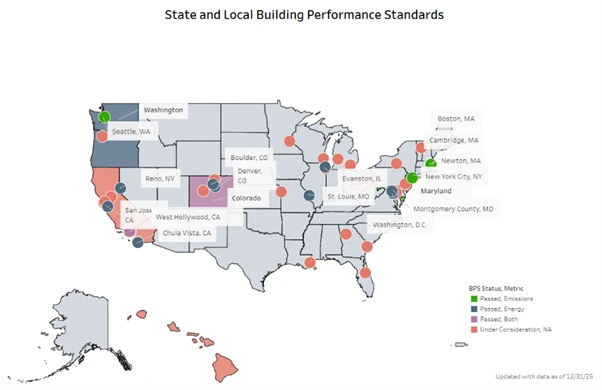
Source: U.S. Department of Energy, Building Energy Codes Program – Building Performance Standards (BPS)
At the same time, building owners are increasingly turning to established sustainability frameworks such as BREEAM to demonstrate long-term performance, enhance asset value, and manage risk. BREEAM is the world’s longest-established building sustainability certification, providing a third-party verified assessment framework for new construction, refurbishment and fit-out, and existing buildings.
The intersection of mandatory performance requirements and voluntary sustainability certification is creating powerful synergies that help real estate owners meet regulatory obligations while future-proofing their portfolios.
Because BPS requirements vary by jurisdiction, owners often face a complex mix of operational obligations that go well beyond basic benchmarking. Our comparison below highlights the core actions required in Washington State and Colorado State, two of the most fully developed BPS frameworks in the United States and how BREEAM In Use supports compliance.
Exhibit 1. Washington State and Colorado State’s BPS Requirements
Exhibit 2. How BREEAM supports BPS compliance in Washington and Colorado State
Together, these comparisons show how BPS requirements are defined and applied across jurisdictions, as well as the level of variation building owners must navigate. The following sections further outline how BREEAM supports compliance while enabling broader performance improvement.
1. BPS Create Mandatory Performance Floors - BREEAM Helps Buildings Rise Above Them
BPS policies set minimum operational performance thresholds, typically using metrics such as energy use intensity (EUI) or greenhouse gas intensity, with annual reporting and penalties for non-compliance.
However, these policies are intentionally narrow, focusing on energy and carbon rather than the full spectrum of factors that determine building resilience, risk exposure, and long-term asset value. BREEAM addresses this gap.
BREEAM In Use can help strengthen and complete what BPS policies start, by evaluating performance across a wider set of sustainability categories, including:
- Health and well-being
- Resilience and circularity
- Water efficiency
- Materials and waste
- Pollution Ecology
This broader lens provides owners with a comprehensive operational roadmap rather than just a compliance target. BREEAM helps them coordinate capital planning, operational improvements, and occupant-focused initiatives in ways BPS regulations often don’t prescribe.
2. BREEAM In‑Use Offers a Portfolio-Friendly Framework for BPS Compliance
BPS policies apply primarily to large existing buildings, usually those over 20,000–50,000 square feet.
BREEAM In‑Use provides portfolio owners with:
- Standardized operational performance tracking
- Third-party verification
- Ongoing improvement cycles
- Cross-market comparability
This makes compliance more manageable, especially for publicly traded REITs, institutional investors, corporate occupiers, higher education institutions, and municipal asset managers that operate across multiple jurisdictions.
3. BREEAM’s Flexible, Non-Prescriptive Structure Supports a Wide Variety of Buildings
Buildings regulated under BPS vary widely in age, condition, ownership structure, and operational complexity. Because BREEAM is flexible and non-prescriptive, it can be applied across a wide range of building types from older assets requiring improvements to newer or specialized buildings focused on performance optimization.
Rather than prescribing specific technologies or design solutions, BREEAM provides a framework that adapts to different:
- Baseline conditions
- Operational challenges
- Investment strategies
- Occupancy patterns
- Market or regulatory context
This flexibility makes BREEAM valuable for a broad range of real estate portfolios, enabling owners to focus on meaningful, feasible improvements regardless of asset age, sector, or configuration. Its strength lies in supporting building teams as they integrate sustainability goals with BPS compliance in ways that fit each building’s unique profile.
4. BREEAM Strengthens Disclosure and Reporting Expectations
Nearly all BPS jurisdictions require:
- Annual reporting
- Public transparency
- Verified, accurate performance data
BREEAM supports these requirements by providing:
- Third‑party‑validated operational data
- Consistent key performance indicators across assets
- Alignment with global investor and reporting frameworks
This not only aids BPS compliance but also enhances credibility with tenants, investors, and regulators.
5. BREEAM Certification Is a Market Differentiator in BPS‑Regulated Cities
With the number of U.S. jurisdictions committed to building performance standards continuing to grow, building owners increasingly need ways to demonstrate credible, proactive action beyond basic compliance.
BREEAM certification indicates an owner’s commitment to taking a structured, measurable approach to managing and improving building performance.
BREEAM helps buildings stand out by communicating:
- A credible, third party‑verified commitment to improvement
- Transparent, validated operational data
- A structured and ongoing approach to managing performance and risk
- Alignment with evolving regulations and market expectations
- A focus on wellbeing, resilience, and environmental quality
This makes BREEAM a meaningful differentiator in BPS-regulated markets, where simple compliance does not set assets apart.
In Summary
U.S. Building Performance Standards define the minimum performance expectations for buildings in terms of energy and greenhouse gas emissions. However, owners need more than compliance; they need a trusted way to navigate complexity, manage risk, and continuously improve in a market where expectations keep rising. BREEAM offers that framework. By providing structure, credibility, and a broader lens on sustainability, it supplies a practical way to strengthen operational performance, enhance resilience, and prepare for what lies ahead.
Browse more from our latest insights:

USA
From risk to value: making sustainability a boardroom priority

USA
Building a Greener Future: Reflections on Greenbuild 2024

USA
Navigating Sustainability: Insights from BREEAM and GRESB Leaders

USA