
Cart (0)
The Chancery Rosewood hotel achieves BREEAM Outstanding for former United States Embassy transformation
How BREEAM helped transform a protected historic landmark into a luxury hotel, balancing heritage conservation, guest experience and high environmental performance.
Overview
Once the United States Embassy in London, The Chancery Rosewood has been transformed into a luxury hotel that achieved BREEAM Outstanding under the BREEAM UK New Construction 2014 scheme. The project demonstrates how BREEAM can support complex redevelopment, balancing heritage conservation, operational performance and ambitious sustainability outcomes.
About
Qatari Diar Europe LLP is an international property developer and investor delivering high-quality developments across a range of sectors. For The Chancery Rosewood, the client sought to create a luxury hotel that respected the architectural significance of Eero Saarinen's Grade II listed building while meeting ambitious sustainability objectives by achieving BREEAM Outstanding.
Background
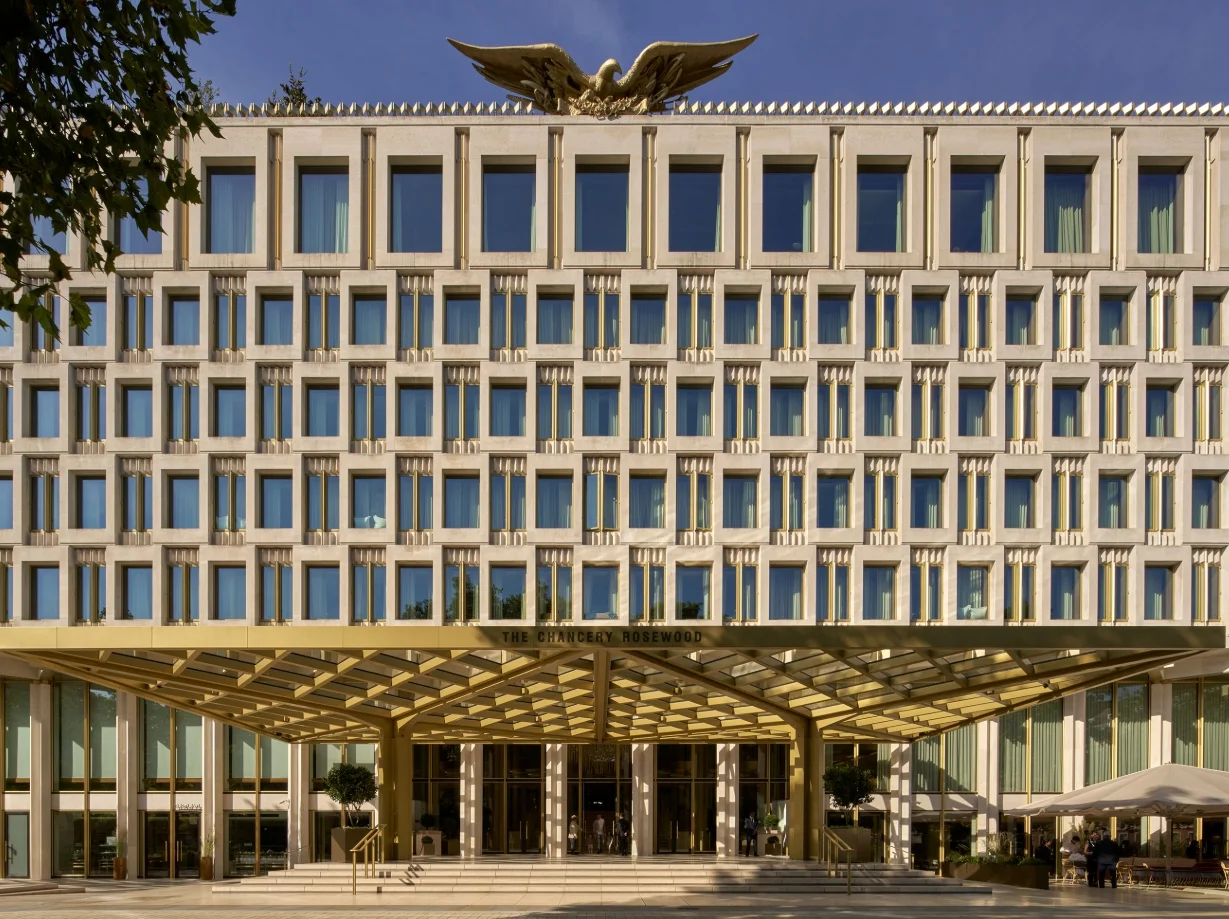
Designed by influential Finnish-American modernist architect Eero Saarinen and constructed between 1955 and 1960, the former United States Embassy occupies a prominent position overlooking Grosvenor Square in London's Mayfair. The building was granted Grade II listed status — a UK heritage designation for buildings of special architectural or historic interest — in 2009, recognising its distinctive exposed concrete diagrid façade and modernist design.
The redevelopment transformed the former embassy into the Chancery Rosewood, a luxury hotel comprising 144 guest suites, restaurants, bars, event spaces, retail, a spa and supporting facilities. The project almost doubled the building's floor area while retaining and restoring key elements of its historic fabric, demonstrating how heritage conservation and sustainability can be successfully integrated within a complex redevelopment.
Challenges
The redevelopment required the careful adaptation of a Grade II listed building while accommodating the operational requirements of a modern luxury hotel. Protecting the building's significant architectural features, including the listed façades and exposed concrete diagrid structure, required bespoke engineering solutions throughout the design and construction process.
The introduction of three new basement levels beneath the retained structure presented a significant engineering challenge, requiring the existing façade to remain suspended above a 30-metre excavation for almost three years. At the same time, the additional rooftop accommodation and enlarged floor area required innovative structural solutions to preserve the integrity of the original building while delivering the client's operational requirements. These challenges were addressed through close collaboration between the project team, enabling the building's heritage significance to be retained alongside the achievement of BREEAM Outstanding.


Solutions
Management
Sustainability was integrated throughout the design and construction process to support the project's ambition of achieving BREEAM Outstanding. Close collaboration between the client, design team and specialist consultants enabled environmental performance to be considered alongside heritage conservation, operational requirements and construction challenges throughout the redevelopment.
Health and wellbeing
The refurbishment enhanced the quality of the internal environment through improved thermal comfort, access to daylight and fresh air. New high-performance glazing improved acoustic performance while maintaining the building's original appearance, and the introduction of balconies on the west façade increased access to natural ventilation for hotel guests.
Energy
The project adopted a comprehensive energy strategy combining improvements to the building envelope with highly efficient building services. Thermal storage, heat recovery and combined heat and power (CHP) systems were integrated to reduce operational energy demand, while the reuse of waste heat contributed to a predicted 46.7% reduction in annual carbon dioxide emissions despite the substantial increase in floor area.
Transport
Located in central London, the Chancery Rosewood benefits from excellent access to public transport and local amenities. The redevelopment also strengthened connections with the surrounding public realm, transforming the former embassy into an accessible destination that contributes positively to the wider neighbourhood.
Water
Water efficiency formed an integral part of the sustainability strategy through the specification of vacuum drainage systems that significantly reduce potable water consumption. These measures contribute to the efficient operation of the hotel while supporting long-term resource efficiency.
Materials
The project prioritised the retention and reuse of existing materials wherever possible, preserving significant architectural elements including the concrete diagrid structure, Portland stone façade, travertine flooring and original joinery. More than 120,000 m³ of material was reused and 100% of construction waste was diverted from landfill, reducing embodied carbon while maintaining the character of the listed building.
Waste
The refurbishment achieved 100% diversion of construction waste from landfill by reusing existing materials and a resource-efficient construction strategy. This approach reduced waste generation while supporting the conservation of the building's historic fabric.
Land use and ecology
Biodiversity enhancements formed part of the wider sustainability strategy through the introduction of extensive green roofs. Existing London plane trees surrounding the site were protected throughout construction in consultation with an arboriculturist, ensuring the redevelopment safeguarded the surrounding landscape while enhancing ecological value.
Pollution
The sustainability strategy focused on reducing operational emissions through energy-efficient building services and improvements to the building envelope. The integration of heat recovery technologies and low-energy systems contributed to lower predicted operational carbon emissions while supporting the long-term environmental performance of the building.
From the beginning, the client was clear they wanted a hotel with exceptional environmental credentials. The project team’s achievement was not only to deliver this but to create an ultra-luxury hotel where all the operational and guest experience requirements were also resolved. Our approach combined retention, reuse and intervention, an innovative building services strategy and a process that embedded environmental performance at every stage of design and construction.
The result is an exemplar amongst UK hotels and wider building typologies of which we can all be proud.
The result is an exemplar amongst UK hotels and wider building typologies of which we can all be proud.
Benefits
BREEAM provided a recognised framework for embedding sustainability throughout the redevelopment of the Chancery Rosewood. The assessment process supported the integration of environmental performance alongside heritage conservation and operational requirements, helping the project deliver a Grade II listed hotel that meets high standards of sustainability.
For the owner, certification demonstrates compliance with recognised environmental standards while supporting the long-term value and resilience of the asset. For the operator, BREEAM Outstanding supports corporate sustainability objectives, contributes to operational efficiency and provides a healthy and comfortable environment for guests and staff.
Achieving BREEAM Outstanding provides independent verification of the project's sustainability performance, demonstrating how the redevelopment successfully combines the conservation of a Grade II listed landmark with high standards of environmental performance. Certification strengthens the environmental credentials of the asset and supports its long-term value by providing confidence to owners, operators, investors and guests that the building has been designed and delivered in accordance with recognised sustainability standards.
Summary
Project title: The Chancery Rosewood Hotel
Location: London
Building type: Commercial/ Hotel
Developer / Client: Qatari DiarEurope LLP
Assessor organisation: Twin & Earth
Assessor: Alicia Freire
Architect: Reardon Smith Architects
BREEAM standard and version: BREEAM UK New Construction 2014
BREEAM rating: Outstanding 86.2%
Photogrpahy:
Front façade showing main entrance & eagle – Edmund Sumner
Restaurant – Ben Anders
Diagrid close-up – Ben Anders
Atrium – Edmund Sumner
Browse more from our latest case studies:
Case Study
Lambeth Palace achieves BREEAM Excellent following major refurbishment
Case Study
Iron Mountain Advances High-Performance Data Centers with BREEAM
UK & Ireland
The Chancery Rosewood hotel achieves BREEAM Outstanding for former United States Embassy transformation
Case Study
Aermont achieves BREEAM Excellent for Manifattura Tabacchi refurbishment

UK & Ireland